Florida's coastal homeowners constantly face brutal high wind risks. But those living in houses built before 2002 face a massive, unique structural vulnerability. Prior to the 2001 Florida Building Code (which became active in March 2002), construction standards completely failed to account for extreme hurricane wind loads. Own an older home? Executing a pre-2002 Florida homes roof retrofit is absolutely critical to secure your property and protect your family.
During a major storm, high winds create massive uplift forces. These forces can literally tear a roof right off its walls if it is not anchored properly. In the Sunshine State, insurers now fiercely demand a pre-2002 Florida homes roof retrofit just to maintain active coverage policies. Reinforce your deck attachments and the connections between your heavy framing and walls. You prevent catastrophic structural failure and rapidly lower your insurance premiums.
Understanding the 2002 Florida Building Code Shift
Following the devastation of Hurricane Andrew, the 2001 Florida Building Code established ruthlessly strict requirements for load paths, impact openings, and deck attachments. Want to see exactly how these rules impact older roofs? Check our comprehensive guide on understanding Florida building codes for roofing.
Engineers assessing older structures hunt aggressively for structural weaknesses that require immediate mitigation. For many homeowners, executing a pre-2002 Florida homes roof retrofit is the only viable way to meet modern safety requirements. Older roofs routinely feature thin nails, incredibly weak framing anchors, and unbraced gable ends. Ignore these upgrades? These homes remain highly vulnerable to severe wind damage and massive policy non-renewals.
Three Crucial Components of a Wind Mitigation Retrofit
A professional wind mitigation retrofit targets specific, highly critical structural failure points. During a pre-2002 Florida homes roof retrofit, expert contractors reinforce three primary areas:
1. Upgrading Roof-to-Wall Connections
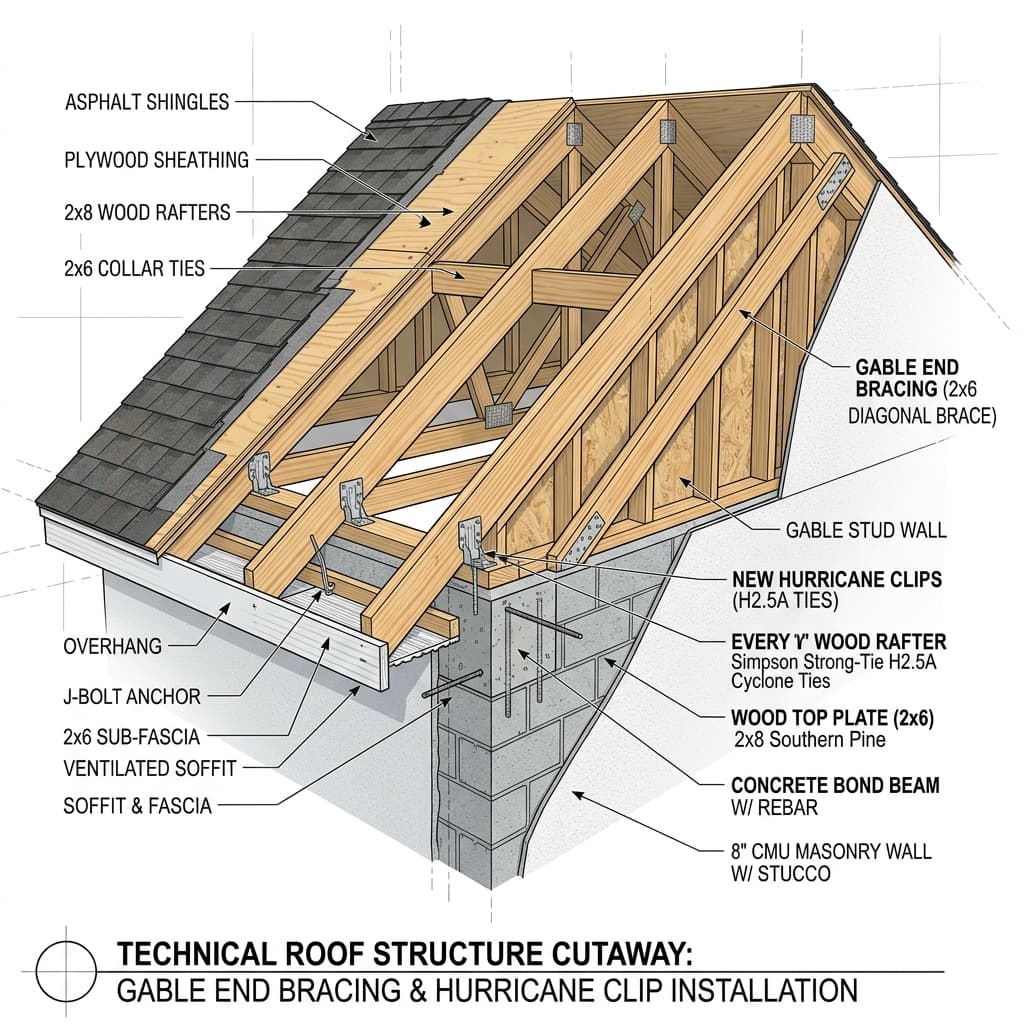
Your roof-to-wall connections act as the absolute most critical link in your home’s wind load path. Pre-2002 homes typically rely on basic toe-nailing. This offers almost zero resistance to extreme wind uplift. Upgrading to heavy three-nail structural hurricane clips is a primary phase of a pre-2002 Florida homes roof retrofit that physically prevents the roof from detaching. For hard details on modern fastening methods, read our breakdown on hurricane roof reinforcement methods.
2. Reinforcing Gable Ends
Gable roofs remain highly vulnerable to devastating lateral winds. During a major storm, a massive gable wall acts exactly like a sail, transferring intense pressure directly to the roof framing. Without heavy support, it collapses and triggers total roof failure. Deploying gable end bracing during a pre-2002 Florida homes roof retrofit distributes this wind load safely. We use heavy diagonal braces and collar ties to physically anchor the gable wall directly to the ceiling joists.
3. Enhancing Roof Deck Attachments
Your roof deck sheathing must be fastened aggressively to prevent high winds from peeling it off like paper. Pre-2002 homes often feature weak staples or short nails. Correcting the deck nailing pattern is a mandatory component of a pre-2002 Florida homes roof retrofit to lock the deck down tight. Installers drive heavy 8d ring-shank nails spaced every six inches and roll out a self-adhered secondary water barrier underlayment for maximum waterproofing protection.
The Financial Benefit: Insurance Credits and Premium Savings
While family safety remains the main goal, the financial benefits are massive. Florida law mandates that insurance companies offer aggressive premium discounts for any home that completes a certified pre-2002 Florida homes roof retrofit.
To lock in these credits, a licensed inspector must file an official OIR-B1-1802 wind mitigation form. For detail on exactly how this works, see our guide on qualifying for insurance wind mitigation credits. Documenting these features guarantees you receive maximum credits. This proves exactly why a pre-2002 Florida homes roof retrofit pays for itself rapidly. Homeowners routinely save 30% to 50% on insurance premiums, pocketing thousands of dollars annually.
Retrofit Process, Timeline, and Costs
Homeowners always ask about the timeline for structural upgrades. While some work can be executed from inside the attic, the absolute most cost-effective approach is completing it during a total roof replacement when the bare deck is fully exposed.
Review this hard overview of the typical cost and aggressive process associated with a professional pre-2002 Florida homes roof retrofit:
| Retrofit Component | Engineering & Installation Process | Estimated Cost Range | Insurance Discount Potential |
|---|---|---|---|
| Roof-to-Wall Connection Upgrade | Adding metal straps or retrofitting existing hurricane clips with a minimum of three nails per connection. | $1,500 - $3,500 | High (Up to 35% premium savings) |
| Gable End Bracing | Installing diagonal and horizontal wooden braces in the attic to reinforce the vertical gable walls. | $1,200 - $2,500 | Medium (Up to 15% premium savings) |
| Roof Deck Attachment | Re-nailing the plywood roof deck with 8d ring-shank nails at a 6-inch spacing pattern. | $800 - $1,500 | High (Required for basic credits) |
| Secondary Water Barrier (SWR) | Installing high-temp self-adhering polymer modified bitumen membrane directly on the bare roof deck. | $1,500 - $3,000 | Medium (Protects against water intrusion) |
Take Action to Protect Your Florida Home Today
Do not wait until a Category 4 storm threatens your family. Schedule a pre-2002 Florida homes roof retrofit immediately to protect your largest investment. Our certified crew stands ready to evaluate your structure and install heavy, code-compliant upgrades fast. View our licensed Florida roofing services to explore our complete wind-hardening options.
Investing heavily in a pre-2002 Florida homes roof retrofit delivers massive structural resilience and absolute peace of mind. Contact us today. Schedule an inspection. Start protecting your home right now.
Related Services and Local Coverage
Whether you need a routine inspection, a fast emergency leak repair, or a massive complete roof replacement, our team handles it all. Discover our comprehensive residential roofing services and heavy-duty commercial roofing capabilities.
Diversified Roofing Solutions protects properties across South Florida and the Treasure Coast. Explore our core service areas in Palm Beach County, Martin County, Broward County, and St. Lucie County.